
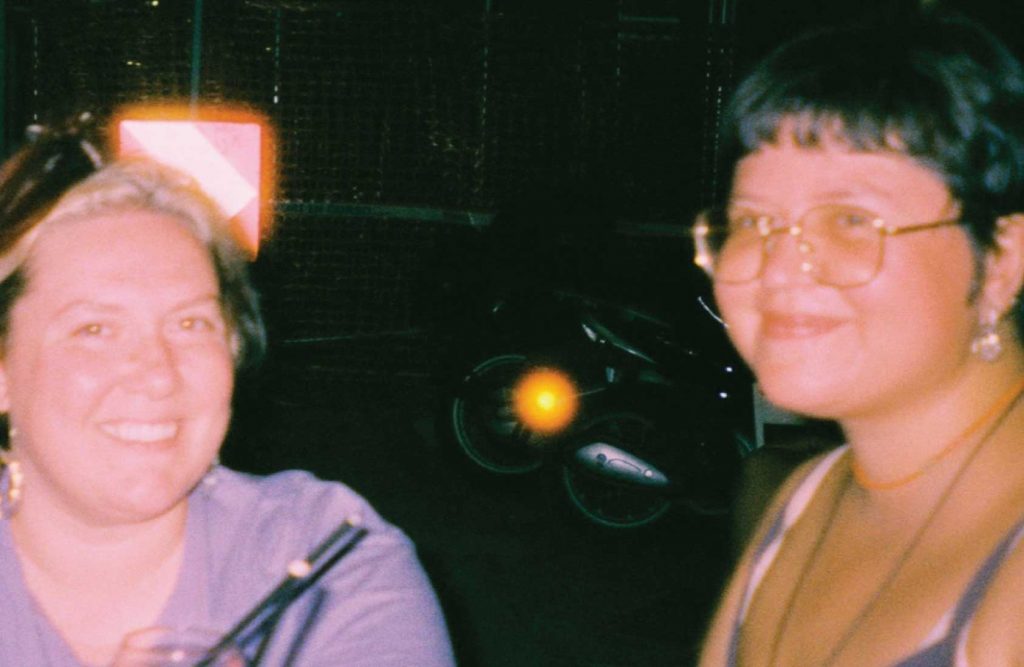
Sophia Archontis (Founder and Curator of Electronic Experimentations) chats with Meredith MacLeod Davidson, Performer for Good Clean Fun x Electronic Experimentations (November 2025)
by Sophia Archontis for Good Clean Fun
I started Electronic Experimentations in February 2025 as a way to provide a place for people working with modalities of electronic music to experiment with performances that may not get booked on your typical club night. In the past almost-year of running Electronic Experimentations, these performances have manifested as DJ sets, ambient sets, hybrid poetry and sound explorations, and experimental music. In September, I was thrilled to partner with Good Clean Fun to allow select performers from these Experimentations nights a second stage. Throughout the autumn, Electronic Experimentations brought six different artists to the first hour of Good Clean Fun events, a collaboration I have been grateful for and excited to curate alongside GCF’s incredible dance parties and meditation hours in Glasgow.
One of November’s Good Clean Fun x Electronic Experimentations performers was Meredith MacLeod Davidson, a writer based in Glasgow. Meredith read poetry and integrated field recording tracks over a backing soundscape of live lap steel guitar. Meredith’s poems and audio addressed themes of climate, loss, intimacy, and spirituality, musings made all the more profound by the presence of the lap steel guitar ringing out between the language. The drone of the strings paired with Meredith’s reading voice and subjects conjured an almost trance-like state for the audience, allowing one to immerse completely in the feelings of presence and absence which mutated with the guitar’s melancholic tones. I personally was deeply affected by the incorporation of field recordings in between readings and music. These recordings were more diaristic: an unedited voice communicating an effort to connect with their surroundings.
I had a lot of questions for Meredith as to how they came up with this performance and wanted to know more about some of the thinking that went into this set. I ask Meredith about this below:
Sophia Archontis: I’m really curious about the recordings you used in your Good Clean Fun Electronic Experimentations set. Tell me a little bit about the process for that – where did these recordings come from?
Meredith MacLeod Davidson: So, I’m primarily a writer, though I’ve been interested in sound art for a few years now. But I only began really experimenting with it in the last year or so. My partner is a musician, so I’ve also spent a lot of time around music scenes and taken a lot of inspiration from that. In February of 2025, I spent a month on a residency where I was staying in a fairly remote area of Central Finland. In advance of travelling for this residency, I bought an old Dictaphone handheld recorder secondhand online, and 3 blank 60-minute tapes. My idea was, I wanted to analog record some of my observations and thoughts about my immediate surroundings, first on the way to Finland (I travelled through Poland, then Estonia on the way there), and then while in Finland, and specifically, while in the forest. I started recording the first tape on the bus to the airport, and kept the Dictaphone on-hand for the next six weeks, pressing record whenever I wanted to catalogue something I was seeing, or anytime I had a sort of meditative thought about “big” ideas, like spirituality, or relationships, history, nature, anything that came to mind. Prior to this, all the work I’d ever made that had met an audience in some way was always hyper-perfected for publication or performance, aka edited and revised multiple times, so with the Dictaphone recordings, I was curious how the inability to edit or revise the work would affect the language and the thinking that comes through it. There’s just what is spoken into the recorder and recorded on the tape in the moment.
SA: What made you decide to work the recordings into experimental pieces?
MMD: After I completed a tape, I would transcribe the recordings into a word document. As I was listening, and then looking at the recordings as text on a page, I was thinking about the textural elements behind this – the crackling sound of the tape recording sounded not so dissimilar from the crunch of my boots walking through a snow-covered forest. The feel of a piece of paper, upon which I write (or print) text, connects you on a tactile level with the afterlife (so-to-speak) of a tree. In the transcription process, I was also noticing similar themes emerge across separate moments of recording, and was curious about what would happen if I connected these disparate recorded moments into a single audio file. After I did that, the audio files still didn’t feel complete, so I decided to have music added to them. I wanted the music tracks that accompanied the voice recordings to have a similarly amateurish quality to them, so the idea was to add music using only basic software and a keyboard, composed on the fly in response to the language.
SA: Specifically with the Dictaphone, I’m curious about the process, what made you speak into the Dictaphone and choose to record what you did?
MMD: When I was travelling on the way to Finland, I tried to record thoughts whenever I was visiting something significant, like an art museum, or a historical site. I also found myself making a lot of recording notes when I was walking around city parks and the like. I started noticing trees in public spaces, and wondering about what the trees have witnessed over their lifespan in major European cities like Krakow or Helsinki. Once I got up to the forest in Central Finland, there was a lot less activity (all the animals were in hibernation) and a lot less historical influence from a human perspective. This required a much deeper thinking and observation of my surroundings. In the several weeks I spent exploring the forest with the Dictaphone, I would often wander until a specific tree “called” to me, then I would sit with the tree for about an hour, and record onto the tape things I observed about the tree and its surroundings in the moment. I tried to observe with senses that didn’t necessarily privilege sight. I was working hard to notice through touch, hearing, and scent. Other less intentional times, I would speak into the Dictaphone whenever I had an especially emotional thought or feeling – I wanted to capture the rawness of that as well as the in-the-moment act of truly noticing my surroundings.
SA: Did any of these recordings bleed into the poems that you wrote, or do you consider the recordings and the poems to be totally separate?
MMD: You know, I’d thought they were totally separate, but you asking that is making me realise that’t not entirely true. There’s one poem I have where I make reference to the act of purchasing the recorder and my intentions with it. I wrote that just before leaving for Finland, and I like that that’s remained in final edits of the poem. I think that’s the only poem which makes specific reference to the tapes and the act of recording, though there’s several other poems I wrote on that residency that absolutely were influenced by the practice of recording and transcribing my voice in the forest. There’s a lot of parallels in imagery between some of my poems and the audio files – certain observations I found so incredibly potent, I’m still working with the material. So I guess my answer is yes, these recordings did bleed into some of my writing, but I also have tried to make both the audio files and the poems exist as separate things. I’ve conducted a version of this Experimentations performance on three different occasions, and I’ve been able to rotate out different recordings and different poems for each performance, and still have the performance be unique and explore something different as a whole set, which has been cool to see work.
SA: I’ve been privileged enough to have witnessed all three of those performances, and I agree, they do something different every time. It’s incredibly nuanced and affecting. How do you think your performance for Good Clean Fun differed from the other performances?
MMD: The team behind Good Clean Fun (Amy, Gary, the DJs, meditation and movement leaders, bar staff, photographers, setup and cleanup crew) are all such incredible people, and everyone has a really sincere interest in human stories, experience, and art, especially art which speaks to the human spirit on an embodied level. I love attending Good Clean Fun events, and the absence of alcohol there really helps me attune to my body, and feel joy in movement and the somatic regulation that comes from dancing en masse with other people. Much of my work with the recordings, sounds, and poems which came together for my performance for Experimentations at Good Clean Fun are working to reach that same sort of embodied consciousness, just in tandem with the natural world, so Good Clean Fun really felt like a perfect audience to bring some of this experimentation to. I was really honoured to perform as a part of GCF, and have been really moved by the feedback I’ve received from people who watched, listened, and connected in some way to my performance.
_________
Sophia Archontis is a multimedia artist originally from Cyprus, now based in Glasgow, Scotland. Her work spans poetry, noise/sound art, photography, and music, and she has been featured in publications Tangerine Dream, From Glasgow to Saturn, as well as exhibitions Urban Coincidence and off-page. She is also a resident on stations Sunny G Radio and Radio Buena Vida, and is the host of the monthly night Electronic Experimentations at The Flying Duck.
Meredith MacLeod Davidson is a Glasgow-based poet and writer, originally from Virginia. Meredith’s poetry has been published in journals that include The London Magazine, Gutter, Anthropocene, Propel, and Poetry Birmingham Literary Journal. Meredith is the co-founder of crisp packet poetry, and co-curates Glasgow’s Discount Guillotine reading series. Transpiration (ignitionpress, 2025) is Meredith’s debut poetry pamphlet.